Album Overview
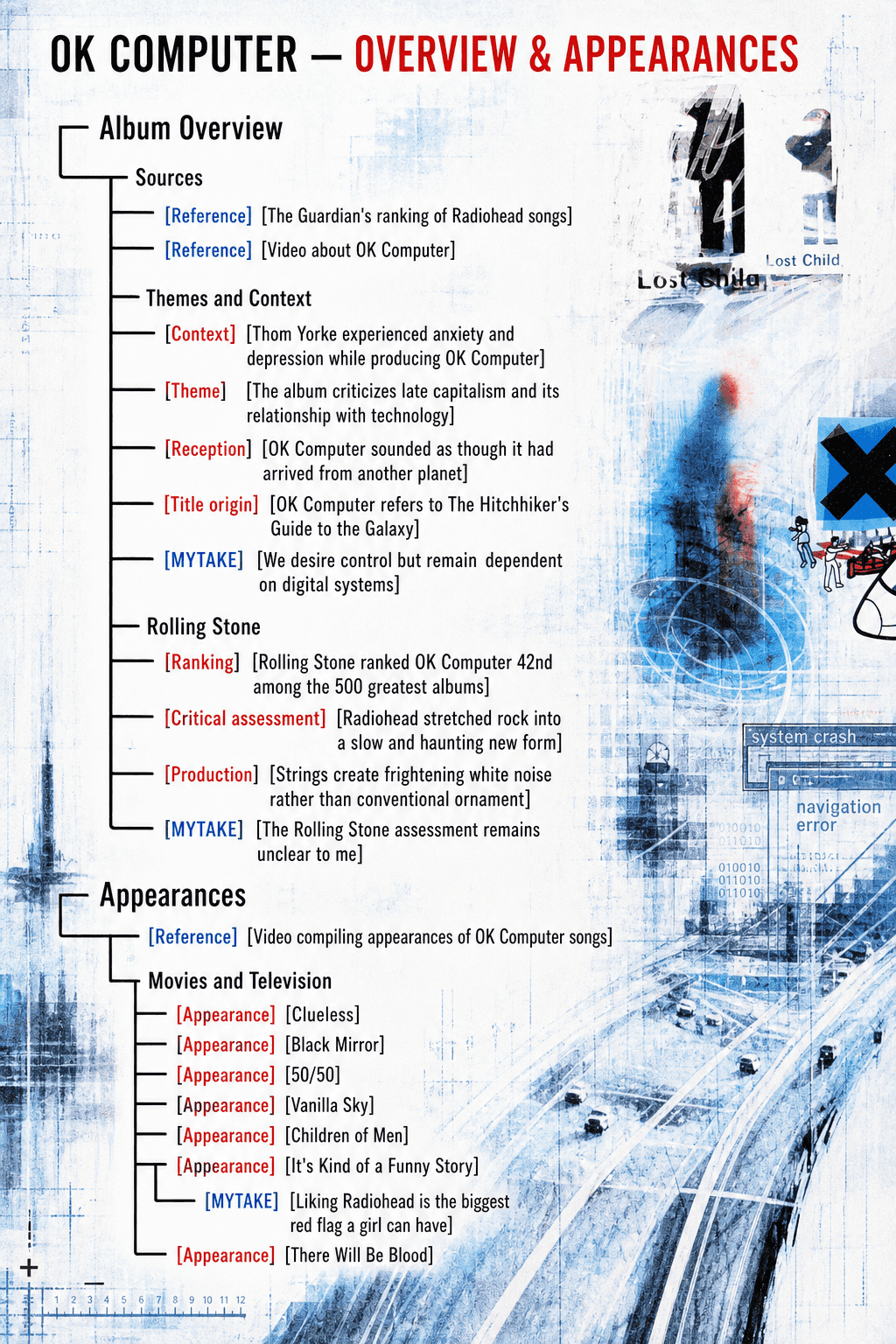
Sources
- [Reference] [The Guardian's ranking of Radiohead songs] https://www.theguardian.com/music/2020/jan/23/radioheads-40-greatest-songs-ranked
- [Reference] [Video about OK Computer] https://www.youtube.com/watch?v=nYYMIYWEdwQ
Themes and Context
- [Context] [Thom Yorke experienced anxiety and depression while producing OK Computer] The album is closely connected to his personal struggles.
- [Theme] [The album criticizes late capitalism and its relationship with technology]
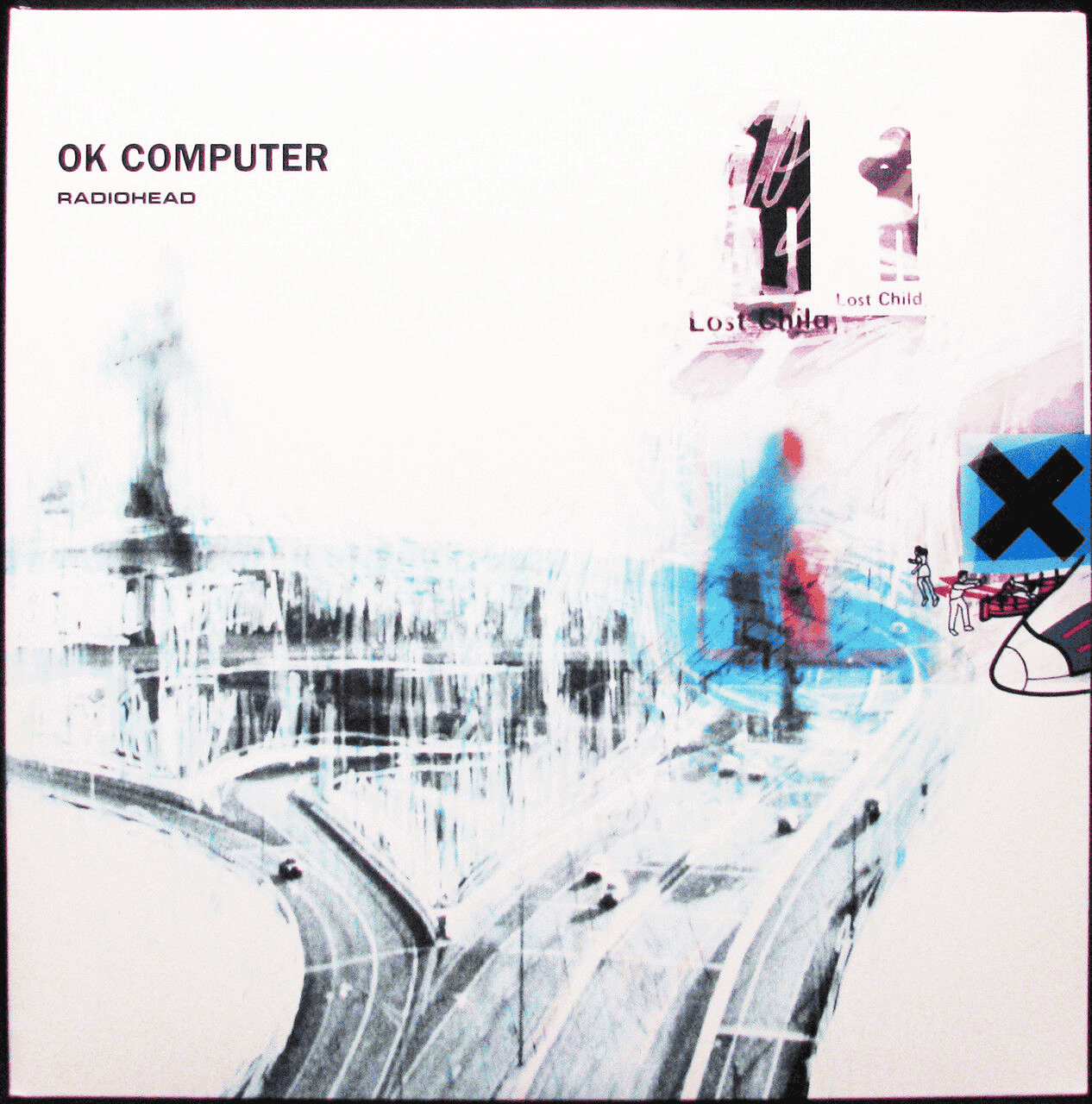
- [Reception] [OK Computer sounded as though it had arrived from another planet]
- [Title origin] [OK Computer refers to The Hitchhiker's Guide to the Galaxy] The title comes from the 1978 radio series, in which Zaphod Beeblebrox says, “Okay, computer, I want full manual control now.”
- [MYTAKE] [We desire control but remain dependent on digital systems] We might like to demand full manual control of our lives, but addiction to Instagram, the internet, and related technologies prevents it.
Rolling Stone
- [Ranking] [Rolling Stone ranked OK Computer 42nd among the 500 greatest albums]
- [Critical assessment] [Radiohead stretched rock into a slow and haunting new form] Rolling Stone describes the band pulling its sound “like taffy” without worrying whether the result remained rock, producing a slow, haunting album with unforgettable tracks such as “Karma Police.”
- [Production] [Strings create frightening white noise rather than conventional ornament] Jonny Greenwood contrasted the album's string arrangements with the model of “Eleanor Rigby” and cited the final chord of “Climbing Up the Walls.”
- [MYTAKE] [The Rolling Stone assessment remains unclear to me] I do not yet understand exactly what the magazine means, but I enjoy seeing an album I love receive such strong recognition.
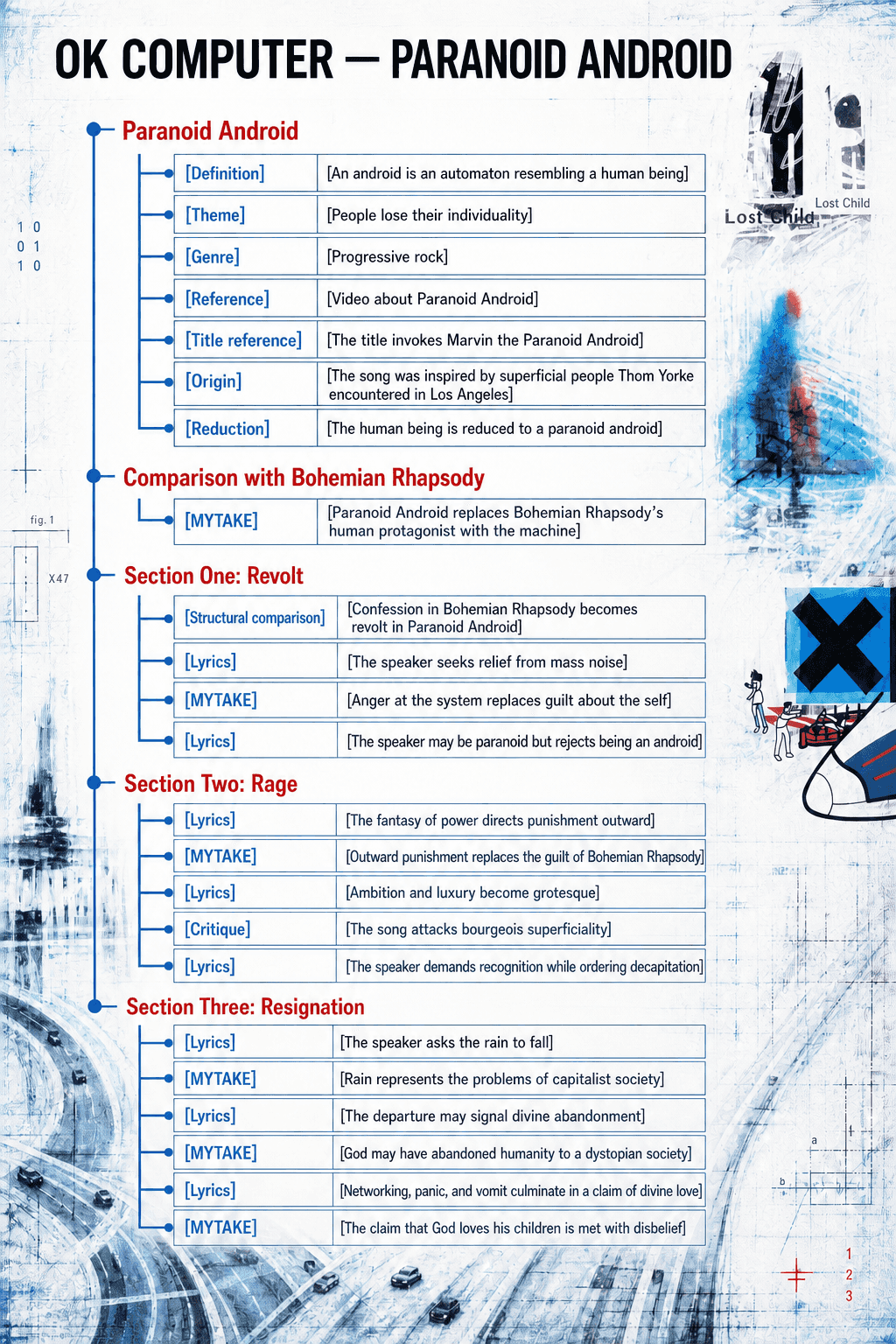
Paranoid Android
Basics
- [Definition] [An android is an automaton resembling a human being]
- [Theme] [People lose their individuality]
- [Genre] [Progressive rock]
- [Reference] [Video about Paranoid Android] https://www.youtube.com/watch?v=TGmh_6Yf5GI
- [Title reference] [The title invokes Marvin the Paranoid Android] The reference comes from The Hitchhiker's Guide to the Galaxy.
- [Origin] [The song was inspired by superficial people Thom Yorke encountered in Los Angeles]
- [Reduction] [The human being is reduced to a paranoid android]
Comparison with Bohemian Rhapsody
- [MYTAKE] [Paranoid Android replaces Bohemian Rhapsody's human protagonist with the machine] The songs are opposites: where Bohemian Rhapsody centers anger about one's own act, Paranoid Android directs anger toward the system and transforms the human being into a supporting actor.
Section One: Revolt
- [Structural comparison] [Confession in Bohemian Rhapsody becomes revolt in Paranoid Android]
- [Lyrics] [The speaker seeks relief from mass noise] “Please could you stop the noise? / I'm tryna get some rest.”
- [MYTAKE] [Anger at the system replaces guilt about the self] This is the key contrast with Bohemian Rhapsody: its character kills someone and becomes angry with himself, whereas this speaker is angry with the system.
- [Lyrics] [The speaker may be paranoid but rejects being an android] “I may be paranoid, but not an android.”
Section Two: Rage
- [Lyrics] [The fantasy of power directs punishment outward] “When I am king / You will be first against the wall.”
- [MYTAKE] [Outward punishment replaces the guilt of Bohemian Rhapsody] The contrast again suggests that humankind has lost the protagonist's role.
- [Lyrics] [Ambition and luxury become grotesque] “Ambition makes you look pretty ugly / Kicking, squealing, Gucci little piggy.”
- [Critique] [The song attacks bourgeois superficiality]
- [Lyrics] [The speaker demands recognition while ordering decapitation] “Why don't you remember my name? / Off with his head, man.”
Section Three: Resignation
- [Lyrics] [The speaker asks the rain to fall] “Rain down, rain down / Come on, rain down on me / From a great height.”
- [MYTAKE] [Rain represents the problems of capitalist society] Capitalism may separate humanity from God and then replace God itself; because capitalism ultimately exists within a world created by God, the rain can still be imagined as coming from God.
- [Lyrics] [The departure may signal divine abandonment] “That's it, sir, you're leaving.”
- [MYTAKE] [God may have abandoned humanity to a dystopian society]
- [Lyrics] [Networking, panic, and vomit culminate in a claim of divine love] “The yuppies networking / The panic, the vomit / God loves his children.”
- [MYTAKE] [The claim that God loves his children is met with disbelief] If God truly loved humanity, why would he leave it in a world like this?
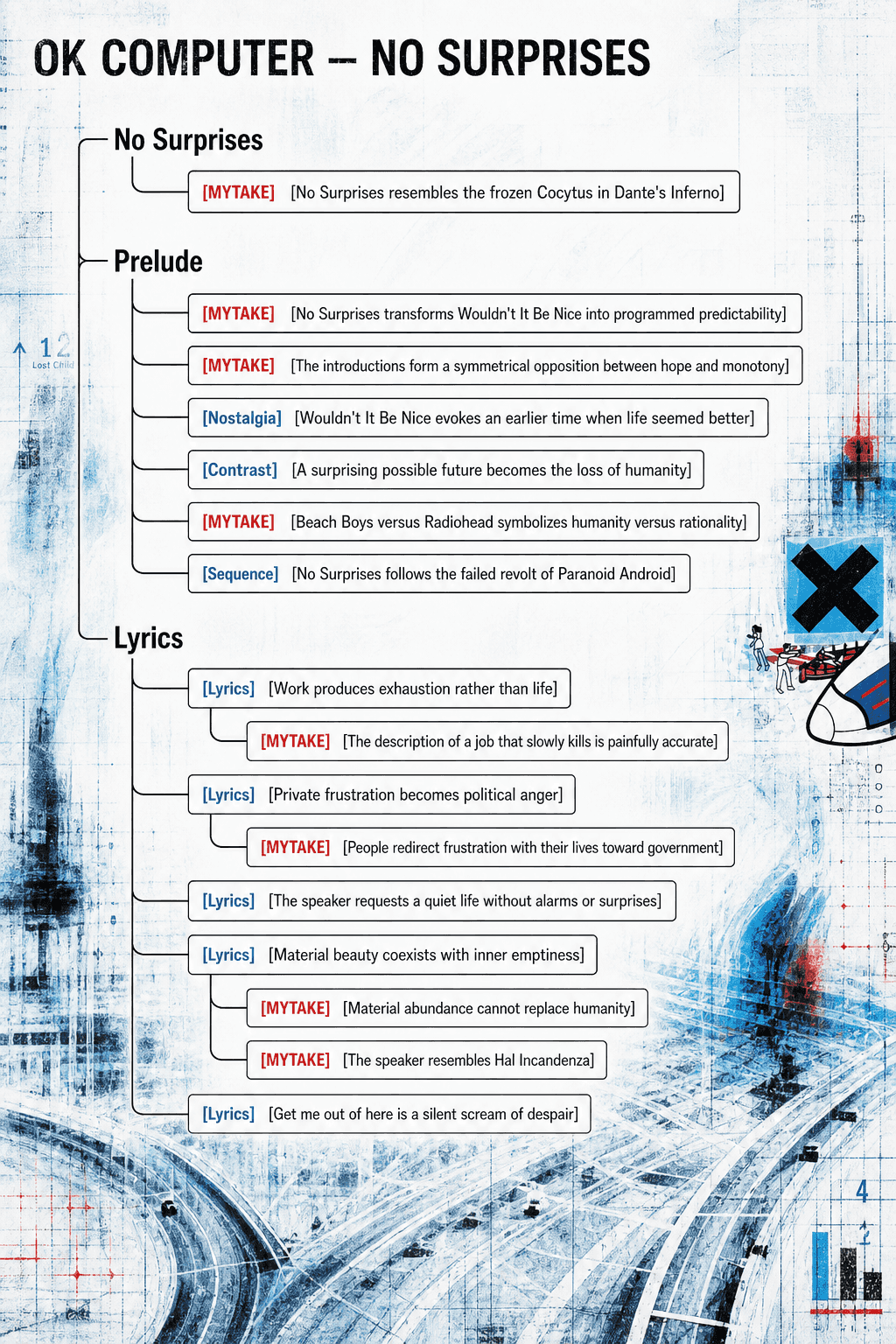
No Surprises

- [MYTAKE] [No Surprises resembles the frozen Cocytus in Dante's Inferno] The song feels cold and without the promise of emotion.
Prelude
- [MYTAKE] [No Surprises transforms Wouldn't It Be Nice into programmed predictability] Its smooth and predictable version of the older song becomes a metaphor for lives programmed by computers.
- [MYTAKE] [The introductions form a symmetrical opposition between hope and monotony] Wouldn't It Be Nice evokes hope, whereas No Surprises evokes monotony.
- [Nostalgia] [Wouldn't It Be Nice evokes an earlier time when life seemed better]
- [Contrast] [A surprising possible future becomes the loss of humanity] Wouldn't It Be Nice imagines good things that could happen, whereas No Surprises depicts humanity's disappearance.
- [MYTAKE] [Beach Boys versus Radiohead symbolizes humanity versus rationality] The contrast between the band names and between Wouldn't It Be Nice and No Surprises reinforces the opposition.
- [Sequence] [No Surprises follows the failed revolt of Paranoid Android] The earlier song stages rebellion; here, the people have already surrendered.
Lyrics
- [Lyrics] [Work produces exhaustion rather than life] “A heart that's full up like a landfill / A job that slowly kills you.”
- [MYTAKE] [The description of a job that slowly kills is painfully accurate] KKKKKKKKKKKKK.
- [Lyrics] [Private frustration becomes political anger] “Bring down the government.”
- [MYTAKE] [People redirect frustration with their lives toward government] This pattern appears during every election cycle in Brazil.
- [Lyrics] [The speaker requests a quiet life without alarms or surprises] The desired escape includes “a handshake of carbon monoxide,” transforming safety and predictability into death.
- [Lyrics] [Material beauty coexists with inner emptiness] “Such a pretty house / And such a pretty garden.”
- [MYTAKE] [Material abundance cannot replace humanity]
- [MYTAKE] [The speaker resembles Hal Incandenza] Like the character from Infinite Jest, he possesses everything required for material happiness but remains unhappy.
- [Lyrics] [Get me out of here is a silent scream of despair]
Karma Police

Prelude
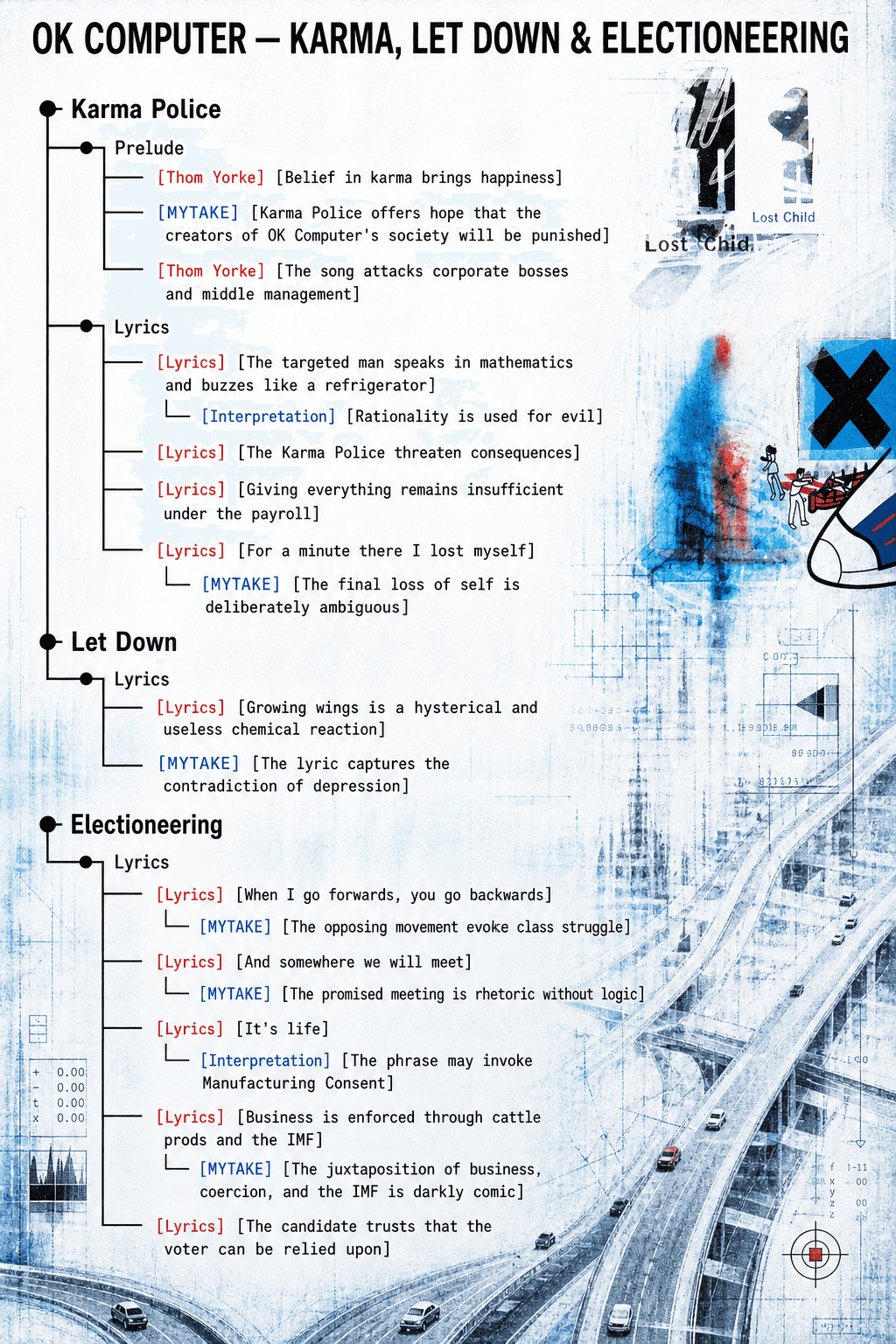
- [Thom Yorke] [Belief in karma brings happiness] Yorke described “Karma Police” as a song dedicated to people who work for large companies and as a song against bosses.
- [MYTAKE] [Karma Police offers hope that the creators of OK Computer's society will be punished] This is a personal interpretation.
- [Thom Yorke] [The song attacks corporate bosses and middle management] “It's for someone who has to work for a large company… This is a song against bosses. Fuck the middle-management!”
Lyrics
- [Lyrics] [The targeted man speaks in mathematics and buzzes like a refrigerator]
- [Interpretation] [Rationality is used for evil]
- [Lyrics] [The Karma Police threaten consequences] “This is what you'll get / When you mess with us.”
- [Lyrics] [Giving everything remains insufficient under the payroll] “I've given all I can / It's not enough / But we're still on the payroll.”
- [Lyrics] [For a minute there I lost myself]
- [MYTAKE] [The final loss of self is deliberately ambiguous] The speaker may be relieved because the guilty were punished, or he may have lost himself because the punishment never occurred and was only a dream.
Let Down
Lyrics
- [Lyrics] [Growing wings is a hysterical and useless chemical reaction] “I'm gonna grow wings / A chemical reaction / Hysterical and useless.”
- [MYTAKE] [The lyric captures the contradiction of depression] Depression can be understood as a chemical reaction and a primarily psychological struggle when no severe material deprivation is present, yet it still feels terrible. Its suffering feels hysterical while serving no reasonable purpose, which makes the experience ironic.
Electioneering
Lyrics
- [Lyrics] [When I go forwards, you go backwards]
- [MYTAKE] [The opposing movement evokes class struggle] KKKKKKKKKKKK.
- [Lyrics] [And somewhere we will meet]
- [MYTAKE] [The promised meeting is rhetoric without logic] The claim makes no sense, and that is the joke: the argument contains nothing beyond rhetoric.
- [Lyrics] [It's life]
- [Interpretation] [The phrase may invoke Manufacturing Consent] It suggests that political conditions are natural and that nothing can be done about them.
- [Lyrics] [Business is enforced through cattle prods and the IMF]
- [MYTAKE] [The juxtaposition of business, coercion, and the IMF is darkly comic] KKKKKKKKKKKKKKKKKKKK.
- [Lyrics] [The candidate trusts that the voter can be relied upon]
Appearances
- [Reference] [Video compiling appearances of OK Computer songs] https://www.youtube.com/watch?v=1wIkL0tPi-o
Movies and Television
- [Appearance] [Clueless]
- [Appearance] [Black Mirror]
- [Appearance] [50/50]
- [Appearance] [Vanilla Sky]
- [Appearance] [Children of Men]
- [Appearance] [It's Kind of a Funny Story]
- [MYTAKE] [Liking Radiohead is the biggest red flag a girl can have]
- [Appearance] [There Will Be Blood]
No comments have been added to this post so far, be the first to add one comment!